Exploring Van Gogh’s ‘Starry Night’ #Synchromysticisim Part 4
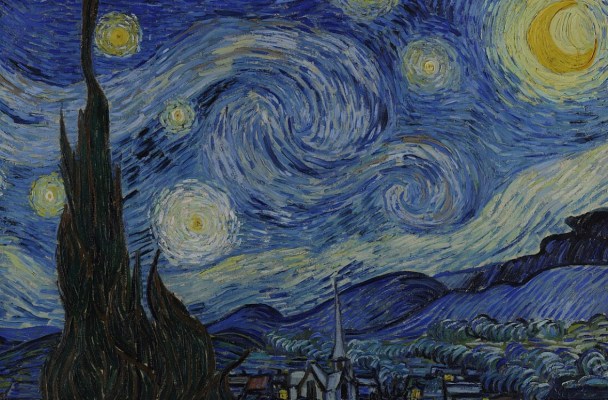
Screenshot
I don’t know anything with certainty but seeing the stars makes me dream.
Vincent Van Gogh
Van Gogh. He’s the French impressionist painter who cut off his ear and got thrown into an insane asylum. That’s where he painted his most famous works of art including “Starry Night.”


I really wasn’t into Van Gogh until I attended a “paint & sip” event. I wanted to write about the event and asked if I could attend.
Paint & sip events never have appealed to me. Copying a painting with a bunch of your friends has always seemed awkward. But I saw an add and I asked to attend thinking the event would make a great article for my magazine.
Intuitively, when I saw the ad I got a weird vibe but proceeded to ask the host if I could attend. “The event is sold out!” she replied.
I attended anyway.
The event was packed but several people canceled. As I met the host I immediately felt something grip my throat as if I was being strangled.
I’m pretty intuitive and in touch with my senses. I’m comfortable going to places and conducting interviews. I know when I’m being psychically attacked. This host did not want me here.
I asked the host if she had a background in art. She said “no.”
But that’s the model for paint & sip: no art background required. Anyone can teach a paint & sip class.
I asked the instructor a few more questions. “You can sit and watch,” she said. Instead I slid into an empty seat. Participating and immersing into the experience is totally different than watching.
As the instructor started the class I quickly found out she was a “lefty “ aka ambidextrous, which sent my dyslexic brain into overdrive. Watching her paint with her left hand, I felt like my eyes were going crossed and my brain was being scrambled. With my dyslexia, I have to always pause when asked to use my right or left hand. I literally have to “think” about it. It only takes a split second. But it still is a “process” and not automatic.
Paint & sip events are supposed to be “relaxing,” but I was getting more and more anxious as the class moved on.
Who wouldn’t? You have no experience. You’re led by a person who’s got literally no experience in art. And you’re painting something a prolific painter painted while they were going through a psychotic break.
The Mantra of Paint & Sip
It’s the blind leading the blind.
The paint & sip model is based on drinking alcohol. In 2002 Wendy Lovoy in Alabama was teaching kids and adults painting classes. She noticed that the adults were taking too long to finish their paintings and were focused on being “too perfect!”
Wendy then added alcohol to her adult classes and “paint & sip” was born. The alcohol serves as “liquid courage” so that adults can unwind, relax and have fun.
What happens when you take a paint and sip class and you choose not to drink alcohol?
I chose not to drink. And like I mentioned before I was slowly getting more and more anxious as the painting process moved on. And yes, my dyslexia was being kicked into high gear.
Most people were drinking. They were loosening their inhibitions. There was laughter. People were insulting each other’s paintings. People were making jokes and it seemed like, for the most part, people were having fun.
However, there was an older woman at the head of my table. She wasn’t drinking and she was not having a good time. Much like myself, it seemed like her anxiety was kicking into high gear. She kept complaining and saying “ I don’t like my painting!”
Her daughters were getting triggered and saying things like “you’re just being too perfect! It’s just you’re OCD!”
No, it was because she wasn’t drinking! In order to enjoy paint & sip, based on the model, you have to drink alcohol in order for it to “work.”
I guess you can say paint & sip is like playing a drinking game. If you don’t drink alcohol, it’s not really fun because the model of “fun” for a drinking game revolves around drinking alcohol and getting drunk.
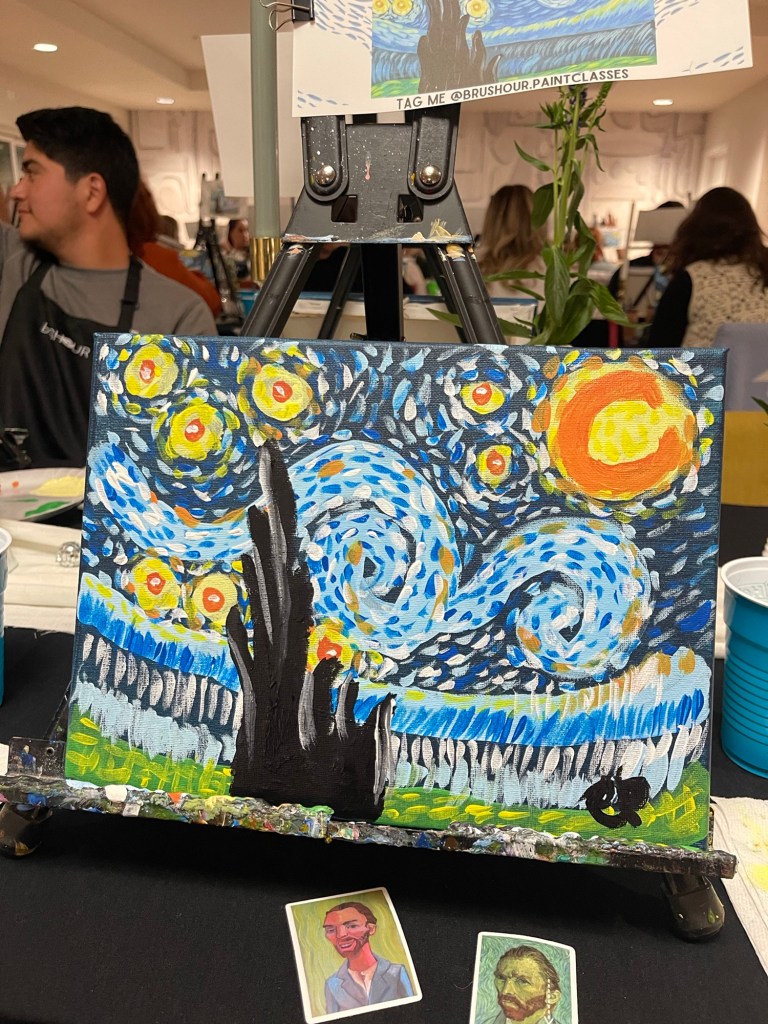
Van Gogh & Starry Night
Oil on canvas. Painted by Vincent Van Gogh in 1889 after he committed himself to an insane asylum.
Although the painting was painted in the daytime, the scenery is of a “starry night sky.” Van Gogh painted a series of paintings, starry night was the only nocturne painting. In a various letters that he wrote his brother Van Gogh called “starry night” his “night study.”
Telescopes, Astronomers & Temporal Seizures
One theory states that “starry night” was painted out of intense feeling and of religious fervor. The hidden content makes reference to the Bible and Revelations, revealing an apocalyptic theme of a woman in pain while giving birth.
Another theory suggests that starry night is a symbol of the cosmos absorbing the artist.
Art historian Albert Boime states that starry night contains many celestial elements including Venus and the constellation Aries. Boime also surmised that Van Gogh had a belief in the afterlife as well as stars and planets.
Although Van Gogh never mentioned astronomer Camille Flammerion, Boime suggests that the spiral nebulous resembles pictures of constellations taken with telescopes.

Harvard Astronomer Charles A. Whitney sees the depiction of spirals in the sky which could be wind and the mistrals that irritated Van Gogh.
Other theories state that Van Gogh was suffering from temporal Seizureshttps://en.m.wikipedia.org/wiki/The_Starry_Night and the swirls are evidence of electrical activity “fireworks” in the brain. It’s said that Van Gogh had given himself over to his imagination.
Galileo’s Dream
In 2020 I read a book called Galileo’s Dream by Kim Stanley, a science fiction/ historical fiction novel which tells the story of Galileo put under house arrest by Pope Urban VIII. Gailieo is afflicted by temporal seizures and is transported to the Galilean Moons in a futuristic time. He meets a group of extraterrestrial beings who tell him he is there to help them avoid a looming apocalyptic war.
The astronomer Camille Flammerion believed in life on Mars and metempsychosis: the transmigration of the soul especially in death.
Was Van Gogh traveling to outer galaxies when he had his temporal lobe seizures? There are vast similarities between the book Galileo’s Dream and what was happening to Van Gogh while he was locked up in the asylum.
Wood Cuts & Tessellations
Starry Night has many slants which resemble would cut art. The slants could also be tessalations which can cause a meditative transcendental experience. Perhaps when Van Gogh was painting starry night he threw himself into a meditative trance that brought on his seizures. And maybe his consciousness did leave his body and travel to different planets and planes in space.
We’ll never know the truth. You must admit, it’s a pretty interesting theory.
 notoriouslysinglegirl
Leave a comment